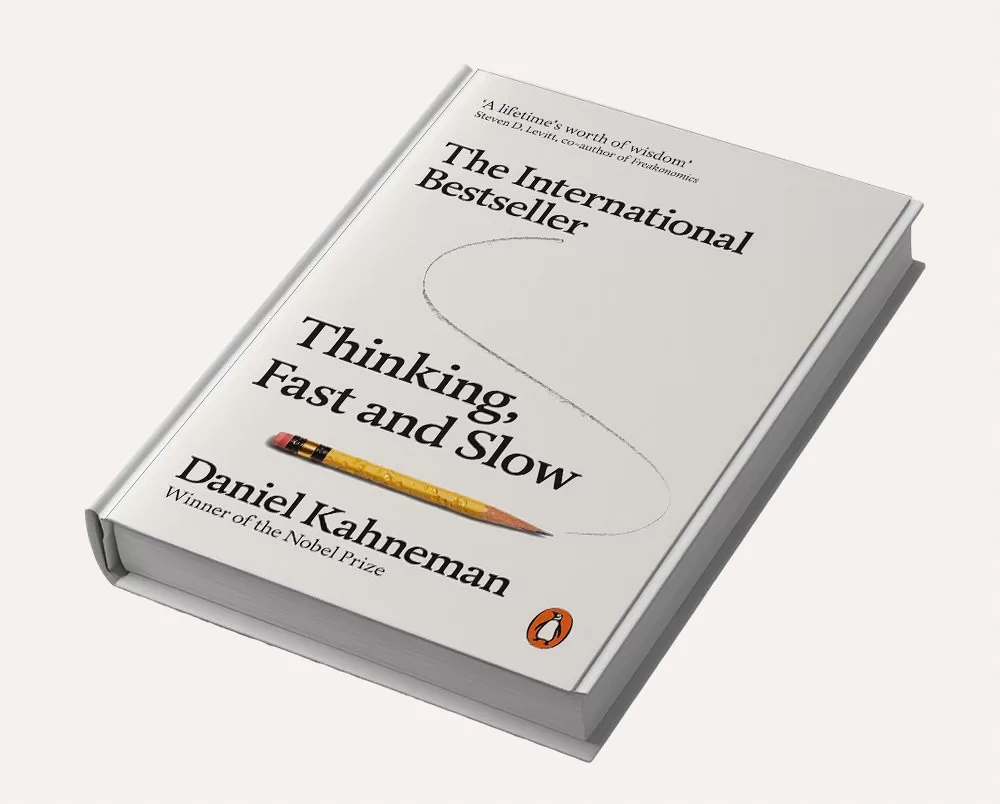
What This Book Is About
Thinking, Fast and Slow reveals how our minds actually work through the groundbreaking concept of two distinct thinking systems. Nobel Prize-winning psychologist Daniel Kahneman shows that System 1 (fast, automatic, intuitive) runs most of our mental life, while System 2 (slow, deliberate, analytical) is often too lazy to intervene—even when System 1 makes predictable errors.
What You’ll Get From Reading This:
- Understanding why you make irrational decisions despite being smart
- Recognizing systematic biases that affect your judgment in relationships, career, money, and health
- Tools to catch yourself before making costly mistakes
- Insight into why other people behave in seemingly irrational ways
- A framework for improving decision-making in high-stakes situations
- Scientific grounding for why willpower, planning, and behavior change are harder than they seem
This isn’t just theory—Kahneman’s decades of research have transformed economics, medicine, public policy, and business strategy. The book translates complex psychology into practical wisdom you can use immediately.
PART 1: The Two Systems & Mental Shortcuts (Chapters 1-17)
Core Concept: How Your Mind Actually Works
Kahneman introduces the two-system framework that explains human thinking:
System 1 operates automatically and quickly, with little effort and no sense of voluntary control. It’s your autopilot—detecting simple relations, completing phrases (“bread and…”), reading emotions on faces, driving on empty roads, and making snap judgments. System 1 evolved to keep us alive by reacting instantly to threats and opportunities.
System 2 allocates attention to effortful mental activities, including complex computations, conscious choices, and deliberate focus. It activates when you’re solving 17 x 24, parking in a tight spot, or making important life decisions. System 2 thinks it’s running the show, but mostly it just endorses System 1’s suggestions.
The problem? System 2 is lazy. It requires real energy (literally—glucose consumption in the brain), so we avoid using it whenever possible. System 1 runs continuously in the background, jumping to conclusions, while System 2 only occasionally checks its work.
The Mental Shortcuts That Mislead Us
Because System 2 won’t do the hard work, System 1 uses heuristics—mental shortcuts that usually work but create predictable errors:
Substitution: When faced with difficult questions, System 1 secretly substitutes easier ones. “Should I invest in this company?” becomes “Do I like this company?” “Is this person competent?” becomes “Does this person look confident?”
Anchoring: The first number you encounter, even if completely random, influences all subsequent judgments. Real estate agents know this—show the expensive house first, and everything else seems reasonable. Negotiators use it—first offer sets the anchor.
Availability Heuristic: We judge probability by how easily examples come to mind. Recent, dramatic, or emotional events feel more common than they are. After seeing news about a plane crash, flying feels dangerous even though statistically it just got safer (one fewer plane with problems in the air).
What You See Is All There Is (WYSIATI): System 1 builds the best story from available information while completely ignoring what’s missing. This creates overconfidence—we don’t know what we don’t know, so we feel certain based on incomplete data.
Regression to the Mean: Extreme performances tend to return to average, but we create false causal explanations. A student who aces one test will likely do worse on the next (regression), but we assume our criticism caused the decline or our praise got in the way.
Why Smart People Make Dumb Decisions
Intelligence doesn’t protect against these biases. A high IQ means your System 2 can do complex thinking, but it doesn’t mean it will. Lazy System 2 afflicts professors and CEOs as much as anyone else.
The bigger problem: once System 1 creates a coherent story, System 2 rarely questions it. We rationalize System 1’s snap judgments rather than truly analyzing them. This explains why brilliant people can hold contradictory beliefs, make terrible investments, and confidently predict outcomes they have no ability to predict.
Practical Relevance: Understanding these two systems explains why behavior change is so difficult—you’re not fighting lack of knowledge, you’re fighting automatic patterns that activate faster than conscious thought. Recognizing when you’re operating on autopilot (System 1) versus genuine analysis (System 2) is the first step to better decisions. Most mistakes happen not from stupidity but from trusting System 1 when System 2 should be activated.
PART 2: Overconfidence & Expert Intuition (Chapters 18-24)
The Illusion of Understanding
Humans have a deep need for coherent narratives. We create stories that explain why things happened—but these stories are constructed after the fact, which creates dangerous illusions:
Hindsight Bias: Once we know an outcome, we believe we “knew it all along.” This makes the past seem more predictable than it actually was. Failed companies look obviously doomed in retrospect. Successful ones appear to have followed a clear strategy. In reality, both faced massive uncertainty and randomness.
Narrative Fallacy: We construct clean cause-and-effect stories, ignoring the role of luck, timing, and randomness. Business books celebrate visionary CEOs, but research shows company performance regresses to the mean—today’s genius is often tomorrow’s cautionary tale.
Illusion of Validity: We feel most confident when we have a coherent story, regardless of the quality of evidence supporting it. A compelling narrative about why a stock will rise feels more certain than statistical analysis showing market unpredictability.
When to Trust Expertise (and When Not To)
Kahneman identifies a crucial distinction: expertise is only valid in predictable environments with rapid, clear feedback.
Valid expert intuition develops in:
- Chess (same rules, immediate feedback)
- Firefighting (pattern recognition from repeated situations)
- Medicine diagnoses (regular patterns, feedback on accuracy)
- Nursing care (immediate patient responses)
Invalid “expertise” in:
- Stock picking (unpredictable, random market movements)
- Long-term political/economic forecasting (too many variables)
- Clinical psychology predictions (low validity despite confidence)
- Wine appreciation (blind tastings show even experts are inconsistent)
The shocking finding: simple statistical formulas consistently outperform expert judgment, even when experts have more information. A basic algorithm using 3-5 factors beats doctors diagnosing patients, loan officers evaluating applications, and HR professionals selecting candidates.
Why do experts resist this? It threatens professional identity. But the solution isn’t eliminating experts—it’s using formulas for prediction and experts for judgment calls where intuition adds value.
The Planning Fallacy & Optimism Bias
We systematically underestimate how long projects will take and how much they’ll cost. This happens because we focus on the inside view (our specific case and all its unique features) while ignoring the outside view (base rates from similar past cases).
Kitchen renovations, software launches, book writing, career transitions—all take longer and cost more than predicted. The cure is reference class forecasting: “How long did similar projects actually take for other people?” Not “How long will mine take given my special circumstances?”
Optimism bias drove you to start a business, write a book, or pursue an ambitious goal despite long odds. Entrepreneurs succeed partly because they’re irrationally optimistic—if they knew the real statistics, they’d never start. But this same bias creates problems in planning, where you need realistic timelines and budgets.
Premortem technique: Before starting a project, imagine it’s failed completely. Write the story of what went wrong. This forces outside-view thinking and identifies risks your optimistic inside view missed.
Practical Relevance: Your confidence in your own judgment is not a reliable indicator of your accuracy. For important decisions—hiring, major purchases, life transitions—use systematic processes and checklists rather than trusting your gut. Save intuition for domains where you have genuine expertise (repeated patterns with clear feedback). For everything else, default to data, base rates, and outside perspectives.
PART 3: Choices, Losses, and Two Selves (Chapters 25-38)
How We Actually Make Decisions
Classical economics assumed people make rational choices to maximize wealth. Prospect Theory (Kahneman’s Nobel Prize work) demolished this assumption with three revolutionary insights:
1. We Think in Gains and Losses, Not Absolutes You don’t evaluate outcomes based on final wealth states—you evaluate changes from your current reference point. Earning ₹1 lakh means different things depending on whether your reference point is ₹5 lakh or ₹50 lakh.
2. Loss Aversion: Losses Hurt Roughly Twice as Much as Gains Feel Good Losing ₹10,000 feels worse than gaining ₹10,000 feels good. This asymmetry drives countless behaviors: holding losing stocks too long, staying in bad relationships, avoiding necessary risks, obsessing over sunk costs.
3. Diminishing Sensitivity The difference between ₹0 and ₹1,000 feels bigger than the difference between ₹10,000 and ₹11,000. This applies to both gains and losses—which creates predictable risk preferences.
The Endowment Effect & Status Quo Bias
Once you own something, you value it more than you would pay to acquire it. Your selling price exceeds your buying price for the identical item. This isn’t rational—it’s loss aversion creating attachment.
This explains resistance to change: your current job, relationship, identity, or belief system feels more valuable simply because it’s yours. Letting go feels like a loss, even when the alternative is objectively better.
Framing: The Same Choice, Different Decisions
Logically equivalent options produce different choices depending on presentation:
- “90% survival rate” vs. “10% mortality rate” (identical statistics, different choices)
- “Save 200 of 600 people for certain” vs. “1/3 chance to save all 600, 2/3 chance to save none”
Frames don’t just influence trivial choices—they determine medical decisions, policy support, and major life choices. Mastering reframing is powerful, but ethical use requires presenting frames that illuminate truth rather than manipulate.
The Two Selves: Experiencing vs. Remembering
Perhaps Kahneman’s most profound insight: you have two selves with different interests.
The Experiencing Self lives in the present moment, feeling each moment as it unfolds.
The Remembering Self keeps score, makes decisions, and tells your life story.
Here’s the problem: You don’t choose between experiences—you choose between memories of experiences. And memories follow bizarre rules:
Peak-End Rule: Your memory of an experience is dominated by the peak (best or worst moment) and the end. The overall duration barely matters (duration neglect).
Classic experiment: People preferred a painful colonoscopy that was longer but ended more gently to a shorter one that ended at peak pain. The Remembering Self (which makes future decisions) ignored total pain and focused on the ending.
Implications:
- A 20-year career is remembered by peak achievements and final years, not average quality
- A 2-week vacation is remembered by best day and last day, not all 14 days
- A 5-year relationship is judged by peak moments and the breakup, not daily experiences
The Remembering Self is tyrannical—it makes all the choices, but the Experiencing Self does all the living. Your memory of your life is not the same as your actual lived experience.
Life Satisfaction vs. Experienced Well-Being
Life satisfaction (how you evaluate your life when asked) depends largely on:
- Goals achieved relative to reference points
- Recent mood and current thoughts
- What you’re focused on when asked (focusing illusion)
Experienced well-being (moment-to-moment quality of life) depends on:
- Time spent in engaging vs. tedious activities
- Social connection vs. isolation
- Autonomy vs. constraint
- Physical comfort vs. discomfort
These don’t always align. You can be dissatisfied with your career (Remembering Self comparing to goals) while actually enjoying daily work (Experiencing Self). Or vice versa—satisfied with accomplishments while daily life feels empty.
The Focusing Illusion: “Nothing in life is as important as you think it is while you’re thinking about it.” When evaluating life satisfaction, whatever’s currently on your mind dominates your assessment—but that’s temporary focus, not permanent reality.
Practical Relevance: You’re making decisions for two different selves. Ask: “Will this create good daily experiences (Experiencing Self) or good memories and achievements (Remembering Self)?” Both matter, but they require different strategies. Design your life for memorable peaks and positive endings, while also ensuring day-to-day experiences are genuinely satisfying. Don’t sacrifice years of experienced well-being for a better story—but don’t ignore the story either, because your Remembering Self makes all future choices.
Key Takeaway
Your mind is not a single rational agent—it’s a fast, intuitive system that jumps to conclusions and a slow, analytical system that’s too lazy to check the work. Most of your mistakes come from trusting System 1 when System 2 should be engaged, from loss aversion that keeps you stuck, from overconfidence in coherent stories built on incomplete information, and from optimizing for the wrong self.
The goal isn’t eliminating System 1—it’s recognizing when you’re running on autopilot and deliberately activating System 2 for decisions that matter. Thinking slow when it counts is the skill this book teaches.
Disclaimer
This is an educational summary of Thinking, Fast and Slow by Daniel Kahneman. All concepts, frameworks, and ideas presented belong to the original author and represent his decades of groundbreaking research in behavioral economics and cognitive psychology.
This summary is intended to help readers: • Understand the book’s core concepts and key insights
• Decide if the full book is relevant to their interests
• Apply foundational ideas to personal and professional decision-making
I strongly encourage purchasing and reading the original work for complete understanding, detailed examples, and the full depth of Kahneman’s research. This 500+ page book contains nuances, experimental evidence, and applications that no summary can fully capture.
Buy Thinking, Fast and Slow: Amazon.com
This summary is provided under fair use for educational and commentary purposes. All credit for the ideas and frameworks belongs to Daniel Kahneman.