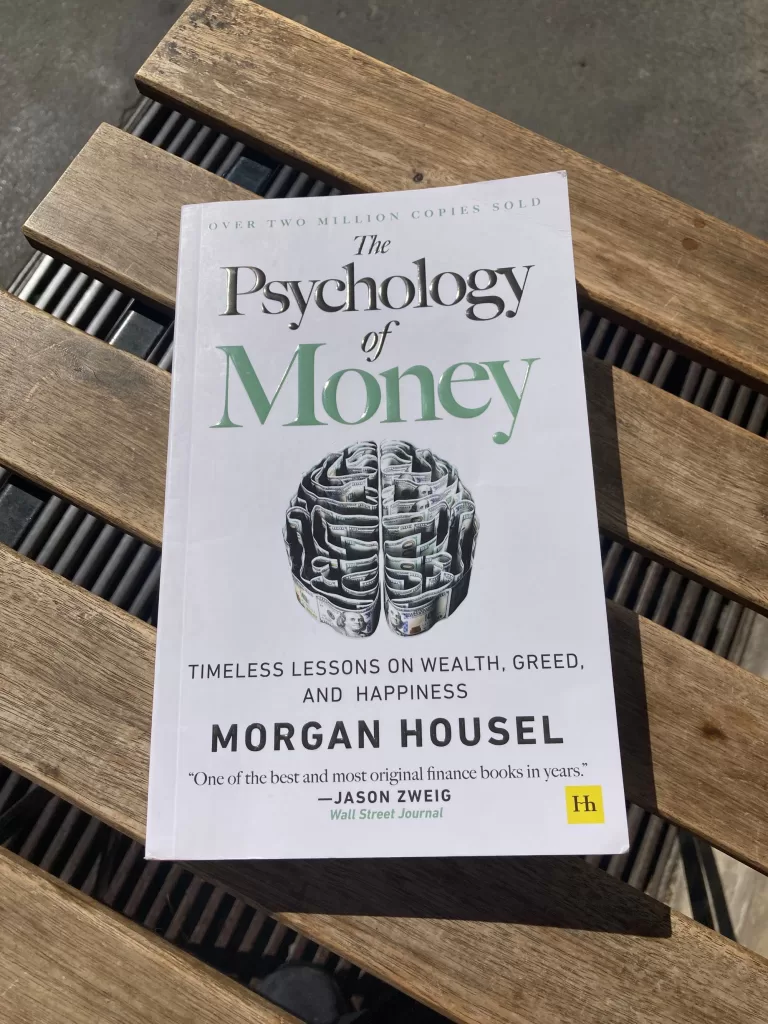
What This Book Is About
The Psychology of Money reveals why managing money successfully has less to do with intelligence and more to do with behavior. Morgan Housel, a financial journalist and investor, demonstrates through compelling stories and research that financial success isn’t about what you know—it’s about how you behave.
What You’ll Get From Reading This:
- Understanding why smart people make terrible financial decisions
- Insight into how your personal history shapes your money beliefs (often invisibly)
- The difference between being rich (high income) and being wealthy (financial independence)
- Why getting wealthy requires different skills than staying wealthy
- How to think about risk, luck, and long-term compounding
- Practical strategies for building wealth that align with human psychology
- Permission to define financial success on your own terms, not society’s
This isn’t a book about stock-picking formulas or get-rich-quick schemes. It’s about the timeless behaviors and mindsets that separate those who build lasting wealth from those who don’t—regardless of income level, intelligence, or education.
PART 1: How We Think About Money (Chapters 1-7)
Your Money Story Shapes Everything
Housel opens with a radical premise: no one is crazy when it comes to money. Your financial decisions make perfect sense given your unique life experiences—but those experiences create blind spots.
Someone who grew up during high inflation sees risk differently than someone who experienced a decade-long bull market. A person who watched their parents lose everything in a business failure will make different choices than someone whose parents built generational wealth through entrepreneurship.
The problem: We assume our experience of the world represents how the world actually works. A 25-year-old who has only known economic growth will take risks a 65-year-old who lived through multiple recessions won’t touch. Neither is “right”—they’re both operating from their personal database of experience.
Key insight: You can’t understand someone’s financial decisions without understanding their personal history. More importantly, you can’t assume your money beliefs are universally applicable.
Luck and Risk: Two Sides of the Same Coin
Bill Gates attended one of the only high schools in the world with a computer in 1968—an extraordinary stroke of luck that led to Microsoft.
Kent Evans, Gates’ equally talented childhood friend, died in a mountaineering accident before graduating high school—an extraordinary stroke of bad luck.
Housel’s point: outcomes are not perfect indicators of decision quality. Someone can make an excellent decision and get a terrible outcome (risk). Someone can make a terrible decision and get an excellent outcome (luck).
This matters because:
- We worship financial success stories without accounting for luck
- We condemn failures without accounting for risk
- We misjudge our own abilities based on outcomes rather than process
The solution: Focus on repeatable behaviors, not specific outcomes. Judge yourself (and others) by decisions made with information available at the time, not by results influenced by randomness.
Never Enough: When More Becomes Destructive
Housel profiles billionaires who committed fraud to make even more money (Rajat Gupta, Bernie Madoff). They had already “won” financially but destroyed everything chasing more.
The hardest financial skill: knowing when you have enough.
The concept of “enough” includes:
- Enough to be happy
- Enough to meet needs and reasonable wants
- Enough to not risk what you have for what you don’t need
Without defining “enough,” the goalpost perpetually moves. You compare yourself to someone wealthier, want what they have, achieve it, then find someone even wealthier to compare yourself to. The cycle never ends.
Housel’s warning: The only way to know how much is enough is to decide in advance. Otherwise, you’ll risk things that are invaluable (reputation, freedom, relationships, health) for marginal financial gains you don’t actually need.
Compounding: The Most Powerful Force in Finance
Warren Buffett’s net worth: $84.5 billion (as of book’s writing).
Warren Buffett’s net worth if he had retired at 60: $25 million.
$84.2 billion of Buffett’s wealth came after his 65th birthday.
Buffett’s genius isn’t just in picking good investments—it’s in picking good investments consistently for 75+ years. His skill is investing, but his secret is time.
Compounding only works if you give it time, which requires:
- Not panicking during downturns
- Not chasing get-rich-quick schemes
- Not interrupting the process by withdrawing money
- Surviving long enough for compounding to work its magic
The counterintuitive truth: Good investing isn’t about making the highest returns—it’s about making pretty good returns consistently over the longest period possible.
Getting Wealthy vs. Staying Wealthy
Getting wealthy requires taking risks, being optimistic, and putting yourself out there.
Staying wealthy requires the opposite: humility, fear that what you have can be taken away, and frugality.
The skills are contradictory, which is why so many people who get wealthy don’t stay wealthy. The aggressive optimism that built wealth becomes the arrogance that destroys it.
Survival mindset for staying wealthy:
- Always assume you can be wrong
- Maintain room for error in every plan
- Never put yourself in a position where a single mistake or stroke of bad luck can wipe you out
- Remember that history is filled with smart people who went broke
Housel’s formula: Survival + adequate returns = extraordinary wealth over time.
Tails Drive Everything
In investing (and life), a small number of events account for the majority of outcomes.
- Index fund reality: The majority of stocks in an index lose money or break even over time. A tiny percentage generate enormous returns that carry the entire index.
- Venture capital reality: Most investments fail. A handful become unicorns that return the entire fund.
- Business reality: Amazon has failed at countless initiatives, but AWS and e-commerce dominate so completely that the failures don’t matter.
What this means for you: You can be wrong half the time (or more) and still do extraordinarily well if you:
- Stay in the game long enough for tail events to work in your favor
- Don’t let failures derail you
- Recognize that a few decisions will matter far more than the majority
Most people quit too early or get discouraged by a string of failures, not realizing that massive success often comes after (and because of) many small failures.
Freedom: The Highest Dividend Money Pays
Housel’s research finding: the highest form of wealth is waking up every morning and saying “I can do whatever I want today.”
Not fancy cars. Not big houses. Not luxury vacations. Autonomy over your time.
People who have control over their time report higher life satisfaction than people with higher incomes but less control. Yet most people chase income in ways that reduce autonomy (longer hours, more stress, golden handcuffs).
The wealth paradox: People get wealthy by sacrificing freedom, then use their wealth trying to buy freedom back—often unsuccessfully because their lifestyle has inflated to match their income.
Practical Relevance: Your financial beliefs aren’t universal truths—they’re shaped by your unique experiences. Understand this about yourself and others. Success in money isn’t about eliminating risk or maximizing returns—it’s about defining “enough,” surviving long enough for compounding to work, and optimizing for freedom rather than status. Most financial mistakes come from forgetting these principles under social pressure or emotional reactivity.
PART 2: Building Wealth That Lasts (Chapters 8-14)
Being Reasonable Over Being Rational
Traditional finance assumes people are rational: they calculate expected values, maximize utility, and make optimal decisions.
Reality: People are emotional, social, and trying to sleep well at night.
Example: Rationally, you should invest 100% in stocks if you have a 30+ year time horizon (historically highest returns). But if a market crash causes you to panic-sell at the bottom, the “rational” strategy failed because it didn’t account for your emotional reality.
Better approach: Aim for reasonable, not optimal.
- A “reasonable” portfolio you can stick with during crashes beats an “optimal” portfolio you abandon when scared
- A “reasonable” savings rate you maintain for decades beats an “optimal” rate you can’t sustain
- A “reasonable” career with work-life balance beats an “optimal” income that destroys your health
Housel’s advice: Financial plans should be designed for survival first, optimization second. The best plan is the one you can actually follow.
Surprise! The Role of Room for Error
The most important part of every financial plan is planning for the plan not to go according to plan.
Life includes:
- Job losses you didn’t see coming
- Medical emergencies
- Market crashes
- Opportunities that require capital
- Expenses you couldn’t predict
Room for error means:
- Emergency fund (6-12 months of expenses minimum)
- Not maximizing leverage
- Not spending to the limit of your income
- Saving more than calculations say you “need”
- Assuming your investment returns will be lower than historical averages
This feels inefficient. You’re “wasting” money sitting in cash. You’re not maximizing returns with leverage. You’re being “too conservative.”
But: Room for error is what keeps you in the game when surprise events happen. And surprise events ALWAYS happen.
Housel’s principle: Avoiding catastrophe trumps maximizing gains. The person who survives inevitable mistakes will outlast the person who optimizes for a perfect world.
You’ll Change (And That’s Okay)
The End of History Illusion: At every age, people recognize they’ve changed dramatically in the past but underestimate how much they’ll change in the future.
Applied to money: The career that seems perfect at 25 may feel like a prison at 40. The financial goals that motivated you before children become irrelevant after. The risk tolerance you had when single shifts when you have dependents.
The trap: Making irreversible financial decisions (massive fixed expenses, golden handcuffs) based on current preferences—then being trapped when those preferences change.
Housel’s solution:
- Avoid extreme financial commitments when possible
- Maintain flexibility (lower fixed costs, higher savings rate, career portability)
- Accept that changing your mind about money goals isn’t failure—it’s growth
- Build wealth in ways that preserve options rather than lock you in
Nothing is Free
Every reward has a price, but the price isn’t always obvious.
- Successful investing’s price: volatility, uncertainty, fear, doubt, regret
- Career success’s price: stress, long hours, delayed gratification, relationships strained
- Entrepreneurship’s price: instability, responsibility, constant problem-solving
Most people try to get the reward without paying the price:
- They want investment returns without experiencing market crashes
- They want career advancement without sacrificing evenings and weekends
- They want business success without dealing with failure and uncertainty
When the bill comes due (market crash, stressful period, setback), they feel cheated—they try to refund the price by panic-selling, quitting, or giving up.
Housel’s reframe: View volatility, uncertainty, and setbacks as the fee you pay for investment returns, career success, or business ownership—not a fine for doing something wrong.
Would you pay a 30% fee for a 10% annual return over decades? If yes, then market crashes are just the fee—pay it and move on. If no, choose a different investment approach with a price you’re willing to pay.
You and Me: Different Games, Different Rules
A day trader and a retirement investor look at the same stock price movements and see completely different things.
- Day trader: Short-term momentum signals
- Retirement investor: Long-term fundamentals
The danger: Taking financial cues from people playing a different game than you.
Examples:
- Following day-trading strategies when you’re a long-term investor
- Comparing your life to someone with different values/goals
- Adopting debt levels appropriate for someone with different risk tolerance
- Chasing status symbols that don’t align with your actual goals
Housel’s warning: You will be tempted to abandon your strategy when you see others making money with different approaches. Remember: they’re playing a different game. Their rules, timeframes, and risk tolerances are different from yours.
The discipline: Define your financial game clearly (long-term wealth building, early retirement, business ownership, etc.) and ignore everyone playing different games—even when they seem to be winning in the short term.
The Seduction of Pessimism
Optimism: “Things will generally improve over time.” Pessimism: “This time is different, everything is broken, collapse is inevitable.”
Pessimism sounds smarter. It seems:
- More serious and thoughtful
- Like you’ve considered all the risks
- Prepared for the worst
Optimism sounds naive. It seems:
- Like you’re ignoring obvious problems
- Pollyanna-ish and foolish
- Unprepared for reality
The data says: Optimism is correct most of the time. Markets trend up. Economies grow. Human problems get solved. Progress compounds.
But: Pessimism feels more urgent and protective. It gets more attention. Media coverage of potential disasters dwarfs coverage of slow progress.
Housel’s insight: Progress is slow, setbacks are sudden. Growth happens gradually over years; recessions happen in months. This makes pessimism feel more real even when optimism is statistically more accurate.
The investor’s challenge: Maintain optimism about long-term trends while staying paranoid about short-term risks. Easy to say, hard to do.
Practical Relevance: Financial success requires being reasonable (emotionally sustainable) over being rational (theoretically optimal), building in room for error because surprises are guaranteed, staying flexible as you evolve, accepting that every reward has a price worth paying, playing your own game regardless of what others are doing, and maintaining long-term optimism despite short-term pessimism being more seductive. These aren’t technical finance skills—they’re psychological disciplines that determine whether you keep your wealth or lose it.
PART 3: Living With Money (Chapters 15-20)
When You’ll Believe Anything
Appealing fictions (get-rich-quick schemes, complex investment products, financial gurus with “secrets”) are more compelling than boring truths (save consistently, diversify, wait decades).
Why we fall for stories:
- The more you want something to be true, the more likely you are to believe a story that makes it seem achievable
- Complex explanations feel more sophisticated than simple ones
- Specific narratives are more persuasive than statistical realities
- We trust storytellers more than data
The antidote: Develop skepticism proportional to how much you want something to be true. The more appealing the story, the more carefully you should scrutinize it.
Warning signs:
- Promises of high returns with low risk
- Complex strategies you can’t explain simply
- Reliance on one person’s genius
- Time pressure to act now
- Claims that “this time is different”
Confessions: Housel’s Own Money Rules
Housel shares his personal approach (which he explicitly states others may disagree with):
Independence is the goal: Every financial decision optimizes for controlling his time.
Saving rate matters more than returns: He saves a high percentage of income and doesn’t stress over optimizing investment returns.
No specific number as “enough”: He wants to work because he wants to, not because he has to—which requires more savings than a retirement calculator suggests.
Doesn’t care about tracking to benchmarks: His goal isn’t beating the market; it’s financial independence and sleeping well.
Cash is valuable: Keeps more cash than “optimal” because room for error and flexibility are worth more than maximizing returns.
Lifestyle inflation is the enemy: As income grows, savings rate grows—not spending.
The point: These rules work for Housel’s personality, risk tolerance, and goals. Yours might be different. The key is consciously choosing rules that align with your actual goals—not defaulting to conventional wisdom or copying others.
Wealth Is What You Don’t See
Rich = current high income (nice car, big house, expensive clothes)
Wealthy = financial assets accumulated over time (freedom, options, security)
You can appear rich while being broke. High income spent on visible status symbols leaves nothing for actual wealth building.
You can appear middle-class while being wealthy. High income with modest lifestyle builds assets that buy freedom.
The invisibility problem: We see and admire rich (expensive purchases) but can’t see wealthy (investment accounts, paid-off mortgage, options). So we mimic the wrong thing.
Housel’s observation: The only way to build wealth is to not spend money. But not spending is invisible—so it’s not admired or celebrated. This makes it psychologically difficult.
The discipline: Admire people with freedom and options, not people with expensive things. Define success by what you have saved and the time you control, not by what you display.
Save Money Without a Reason
Traditional finance: Save for specific goals (retirement, house down payment, child’s education).
Housel’s alternative: Save for things you can’t yet imagine.
Why:
- Life is unpredictable—best opportunities often come unannounced
- Having capital when others don’t gives you options
- Flexibility has enormous value even if you can’t quantify it
- You don’t know what you’ll want in 10 years
The power of savings without a purpose:
- You can take career risks others can’t
- You can wait out market downturns
- You can say no to opportunities that don’t fit
- You can say yes to opportunities that do
Housel’s principle: Savings = a hedge against life’s inevitable surprises. You don’t need to justify every dollar saved with a specific future purchase.
Reasonable Over Rational (Revisited in Action)
The rational approach: Calculate optimal asset allocation, stick to it regardless of emotions, rebalance mechanically.
The reasonable approach: Build a portfolio you can actually hold during crashes—even if it’s not theoretically optimal.
Example: If 100% stocks is “optimal” based on your timeline, but you’d panic-sell during a 40% crash, then 100% stocks is actually a terrible strategy for you. Better to hold 70% stocks and 30% bonds, stay invested through crashes, and get lower returns with higher actual outcomes.
Housel’s insight: The optimal strategy you can’t follow is worse than the reasonable strategy you stick with for decades.
This applies beyond investing:
- Reasonable side hustle you maintain > optimal business you burn out on
- Reasonable budget you follow > optimal budget you abandon
- Reasonable career with sustainability > optimal income with misery
The Man in the Car Paradox
What you think when you see someone in a Ferrari: “Wow, people will really respect and admire me if I have that car.”
What people actually think: “Wow, a Ferrari. I wonder if I could afford one someday.” (They’re thinking about themselves, not you.)
Housel’s observation: We use expensive purchases to signal success and earn respect—but the signal doesn’t work. People don’t admire you; they admire the object and imagine themselves owning it.
The irony: You sacrifice financial security and freedom to buy respect—but you don’t actually get the respect, just debt.
What actually earns respect: Humility, kindness, genuine skill, or wealth used to help others—not stuff.
Practical Relevance: True wealth is invisible—it’s assets you’ve accumulated, not income you’ve spent. Save for flexibility and options, not for specific goals or status. Build financial strategies you can actually maintain emotionally, not theoretically optimal plans you’ll abandon under pressure. Stop using money to impress people who aren’t thinking about you anyway. These simple but psychologically difficult principles separate those who build lasting wealth from those who look wealthy while going broke.
Key Takeaway
Financial success is not about what you know—it’s about how you behave.
Smart people go broke. Average people build fortunes. The difference isn’t intelligence, education, or inside information. It’s behavior: managing emotions, defining enough, maintaining room for error, staying in the game long enough for compounding to work, and optimizing for freedom rather than stuff.
Housel’s core message: Personal finance is personal. Your history, psychology, goals, and risk tolerance are unique. Stop following generic rules or copying others. Instead, understand how you think about money, accept that different people need different strategies, and build an approach you can stick with for decades—because time is the most powerful variable in finance, and behavior determines whether you get to use it.
Disclaimer
This is an educational summary of The Psychology of Money: Timeless Lessons on Wealth, Greed, and Happiness by Morgan Housel. All concepts, frameworks, stories, and insights presented belong to the original author and represent his years of research into financial behavior and investment psychology.
This summary is intended to help readers: • Understand the book’s core behavioral finance principles
• Decide if the full book is relevant to their financial development
• Get a preview of how psychology drives financial outcomes
I strongly encourage purchasing and reading the original work for complete understanding, detailed stories, research backing, and the nuance that makes Housel’s writing so compelling. The book contains case studies, historical examples, and personal reflections that bring these concepts to life in ways no summary can fully capture.
This summary is provided under fair use for educational and commentary purposes. All credit for the concepts and insights belongs to Morgan Housel.
If the topic of money interests you I recommend you read
“Rich Dad, Poor Dad” by Robert Kiyosaki
“Secrets of the Millionare Mind” by T Harv Eker
“The Richest Man in Babylon” by George Samuel Clason
“I love Money” by Suresh Padmanabhan
You would have read in the About section that I was in a deep debt trap till a decade ago and all these books helped me get out of debt and change my relationship with money.