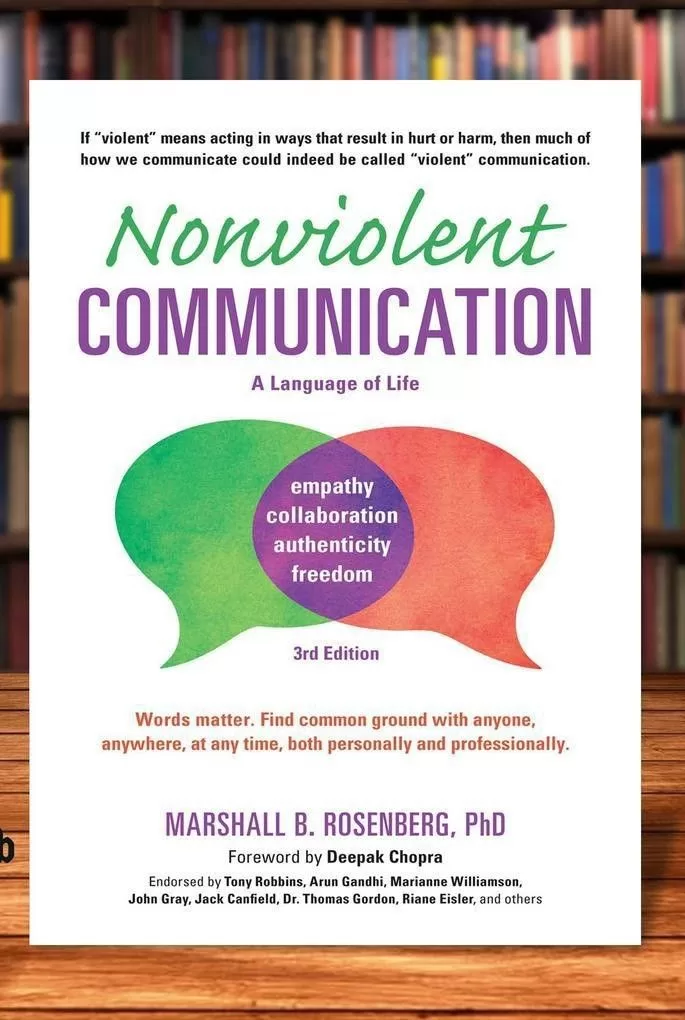
What This Book Is About
Nonviolent Communication (NVC) presents a revolutionary approach to human connection that transforms how we speak, listen, and resolve conflicts. Marshall Rosenberg’s framework replaces habitual patterns of judgment, criticism, and demands with a compassionate process that meets everyone’s needs.
What You’ll Get From Reading This:
- A practical four-step process (Observations, Feelings, Needs, Requests) for expressing yourself honestly without blame
- Skills to listen deeply even when someone is attacking or criticizing you
- Understanding of how language patterns create disconnection and conflict
- Tools to resolve seemingly impossible conflicts in relationships, parenting, and work
- Ability to hear the needs behind anger, criticism, and resistance
- A framework for self-compassion that eliminates shame and self-judgment
- Methods for navigating difficult conversations without compromising your values or the relationship
NVC isn’t just communication theory—it’s been used successfully in war zones, prisons, schools, corporations, and families worldwide. Rosenberg shows that underneath every human action is an attempt to meet universal needs, and when we connect at that level, conflicts dissolve and genuine understanding emerges.
PART 1: The Foundation – How Language Creates Connection or Violence (Chapters 1-4)
Two Ways of Communicating
Rosenberg distinguishes between life-alienating communication (judgment, criticism, demands, diagnosis) and life-serving communication (observations, feelings, needs, requests). Most of us were raised speaking the former, which creates defensiveness, resistance, and disconnection.
Life-alienating patterns include:
- Moralistic judgments: “You’re selfish/lazy/irresponsible”
- Comparisons: “Why can’t you be more like…”
- Denial of responsibility: “I had to…” “You made me…”
- Demands disguised as requests: “Would you please…” (said with threat of consequences)
These patterns trigger defensiveness because they imply wrongness, which humans instinctively resist. Even when the criticism is accurate, the delivery prevents genuine hearing.
The Four Components of NVC
1. Observations (Without Evaluation)
Separate what actually happened from your interpretation of it.
Evaluation: “You never listen to me.”
Observation: “When I shared my work concern yesterday, you looked at your phone three times.”
The difference seems subtle but is profound. Evaluations trigger defensiveness (“That’s not true! I listen plenty!”). Observations are harder to argue with because they’re specific and factual.
2. Feelings (Not Thoughts Disguised as Feelings)
Express the actual emotion, not your interpretation or thought.
Thought disguised as feeling: “I feel like you don’t care.”
Actual feeling: “I feel hurt and lonely.”
Real feelings are body-based sensations—scared, sad, angry, joyful, peaceful. “I feel that you…” or “I feel like…” are thoughts, not feelings. This distinction matters because genuine feelings create empathy; thoughts create debate.
3. Needs (Universal Human Needs)
Connect your feeling to the underlying need that’s met or unmet. All feelings arise from needs—when needs are met, we feel pleasant emotions; when unmet, painful emotions.
Universal needs include: autonomy, connection, understanding, respect, safety, meaning, celebration, physical well-being, honesty, play, peace.
The shift: “I feel hurt because I need to be heard and understood” (vs. “I feel hurt because you’re inconsiderate”).
This is revolutionary: your feelings are caused by YOUR needs, not by what others did. They may have triggered the feeling, but the feeling comes from your unmet need.
4. Requests (Clear, Specific, Doable Actions)
Ask for concrete actions that would meet your needs—not vague demands.
Vague: “I need you to respect me more.”
Clear request: “Would you be willing to put your phone down when I’m sharing something important?”
Requests must be:
- Positive (what you DO want, not what you don’t)
- Specific (concrete action, not attitude change)
- Doable right now or in near future
- Actually requests (the person can say no)
Why This Works: The Shift From Judgment to Needs
Traditional communication focuses on who’s right/wrong, good/bad. NVC shifts to: what needs are alive in each person, and how can we meet them?
When someone criticizes you (“You’re so controlling!”), NVC hears: “They have an unmet need—probably autonomy or choice.” This transforms your response from defense to curiosity.
When you’re angry at someone, NVC asks: “What need of mine is unmet?” Not “What’s wrong with them?” This shifts you from blame to clarity about what you actually want.
Practical Relevance: Most conflicts aren’t actually about the surface issue (dirty dishes, late arrival, tone of voice)—they’re about unmet needs for respect, consideration, autonomy, or connection. When you address needs rather than debating the triggering event, resolution becomes possible. The four components give you a roadmap out of blame-defend cycles into genuine understanding.
PART 2: Receiving With Empathy & Self-Connection (Chapters 5-9)
Empathy: Hearing Needs Behind Words
NVC’s most powerful tool is empathic listening—hearing the feelings and needs behind whatever someone says, no matter how they say it.
When someone says: “You never think about anyone but yourself!”
Traditional response: Defend (“That’s not true!”), counter-attack (“Well you’re not exactly considerate either”), or collapse (“You’re right, I’m terrible”).
NVC empathy: Hear the need behind the words. “Are you feeling frustrated because you need more consideration in our decisions?”
You’re not agreeing with their judgment—you’re connecting with their pain. This defuses attacks because the person feels truly heard, often for the first time.
The Empathy Process
Empathy means:
- Emptying your mind of preconceived ideas and judgments
- Being present with the other person’s feelings and needs
- Reflecting back what you hear (without parroting words)
- Staying with their experience until they feel fully received
Empathy doesn’t mean:
- Agreeing with them
- Fixing their problem
- One-upping with your similar story
- Giving advice
- Explaining or educating
Common empathy blocks Rosenberg identifies:
- Advising: “Here’s what you should do…”
- One-upping: “That’s nothing, let me tell you…”
- Educating: “Actually, the real issue is…”
- Consoling: “It wasn’t your fault…”
- Story-telling: “That reminds me of when I…”
- Shutting down: “Cheer up, don’t feel bad…”
- Interrogating: “When did this begin? Why did you…”
- Explaining: “I would have called but…”
- Correcting: “That’s not exactly what happened…”
All these responses, however well-intentioned, shift attention away from the person’s feelings and needs. Empathy stays with their experience.
Empathy Before Education
When someone is in pain, upset, or defensive, they literally cannot hear your perspective. Their brain is in threat response.
The sequence matters:
- First, give empathy (reflect their feelings and needs)
- Wait until they feel fully heard (often signaled by release of tension, deeper breath, or “yes, exactly”)
- Only then can they hear your feelings and needs
Trying to explain, defend, or educate before giving empathy is like trying to download data to a computer that’s not connected—it simply won’t receive.
Self-Empathy: The Foundation
Before you can give genuine empathy to others, you need to connect with your own feelings and needs. Self-empathy means:
Stop and ask yourself:
- What am I feeling right now?
- What need of mine is unmet?
- What am I really wanting?
This prevents you from acting out of guilt, shame, obligation, or reactive anger. When you’re clear on your own needs, you can engage authentically rather than from resentment or people-pleasing.
Expressing Anger Nonviolently
Rosenberg challenges the common belief that anger is caused by what others do. Anger is caused by life-alienating thinking—specifically, judgments that others are wrong, bad, or deserving of punishment.
The cause of anger: Thinking “He shouldn’t have…” or “She’s so selfish…” creates anger.
The stimulus: What the person did simply triggered your awareness of an unmet need.
NVC anger process:
- Stop and breathe (don’t act from anger)
- Identify the judgmental thought creating the anger
- Connect with the need behind that judgment
- Express the need without blame
Example:
- Judgment creating anger: “She’s disrespectful for being late again!”
- Underlying need: Reliability, consideration, valuing my time
- NVC expression: “When you arrived at 8:15 for our 7:30 meeting, I felt frustrated because I really value reliability and consideration for each other’s time. Would you be willing to call if you’ll be more than 10 minutes late?”
The anger was real, but expressing it from needs rather than judgment creates possibility for change rather than defensiveness.
Practical Relevance: Empathy is not a soft skill—it’s the most powerful tool for de-escalating conflict and creating genuine change. When someone feels truly heard (not agreed with, but heard), their nervous system literally calms, and they become capable of hearing you. Self-empathy prevents burnout, resentment, and people-pleasing by keeping you connected to your authentic needs. This doesn’t mean you always get what you want, but you act from clarity rather than confusion.
PART 3: Application – Using NVC in Real Life (Chapters 10-13)
Expressing Full Self-Expression Honestly
NVC isn’t about being nice or suppressing difficult truths—it’s about expressing your full truth in ways that can be heard.
The complete NVC expression includes all four components:
“When you [observation], I feel [feeling] because I need [need]. Would you be willing to [request]?”
Example in a relationship: “When I heard you tell your mother we’d visit next weekend without asking me first, I felt hurt and annoyed because I need partnership in decisions that affect us both. Would you be willing to check with me before committing us to plans?”
This is honest AND respectful. You’re not attacking, but you’re also not pretending everything is fine.
Receiving Empathically in Difficult Situations
When receiving criticism or attack:
Person says: “You’re the worst manager I’ve ever had!”
Don’t: Defend, explain, or counter-attack
Do: Hear the need behind the words.
NVC response: “Are you feeling frustrated because you’d like more support/clarity/autonomy in your work?” (guessing at their need)
This interrupts the attack-defend cycle. Usually the person says “Yes!” and the conversation shifts to problem-solving.
When receiving a “no”:
Don’t hear rejection—hear that the person has a need that conflicts with your request. Get curious: “I’m sensing some reluctance. Can you help me understand what’s making this difficult for you?”
Their “no” to your request is often a “yes” to one of their own needs (autonomy, rest, different priority). When you hear the underlying need, you can often find creative solutions that meet both people’s needs.
Using NVC With Ourselves: Mourning and Self-Forgiveness
We often speak violently to ourselves: “I’m so stupid. I always mess up. What’s wrong with me?”
NVC for self-compassion:
- Notice the self-judgment
- Identify the unmet need behind the self-judgment
- Mourn the need with empathy for yourself
- Shift to what you can do differently
Example:
- Self-judgment: “I’m such an idiot for snapping at my child.”
- Need awareness: “I value patience and presence with my child.”
- Self-empathy: “I’m feeling regret because I really want to parent with patience.”
- Request to self: “Next time I feel that tension, I’ll pause and take three breaths before responding.”
This is radically different from self-punishment, which creates shame and doesn’t lead to change.
Expressing Appreciation
NVC appreciation has three components:
- What the person did (observation)
- How you feel about it (feeling)
- What need was met (need)
NVC appreciation: “When you took time to explain that concept three different ways, I felt relieved and grateful because I really needed understanding and patience as I learned this.”
vs.
Generic praise: “You’re a great teacher!” (This is actually an evaluation, which NVC suggests avoiding even when positive—it still positions you as judge.)
NVC appreciation is specific, connects to feelings and needs, and gives genuine feedback the person can learn from.
Protective vs. Punitive Use of Force
Rosenberg acknowledges that sometimes force is necessary (restraining a child from running into traffic, removing someone from a situation).
Punitive force: Intended to make someone suffer so they’ll change behavior (punishment, guilt, shame).
Protective force: Prevents harm without intent to cause pain or shame.
NVC supports protective force when necessary, but never punitive force—because punishment creates resentment, not genuine change.
The Goal: Creating Connection, Not Compliance
NVC’s ultimate aim is connection and mutual respect, not getting your way.
Sometimes this means:
- You make the request and the person says “no” → and you accept their “no” with empathy
- You discover that meeting your need in the way you planned would cost the other person too much → so you find a different strategy
- You realize your “need” was actually a strategy, and when you connect with the deeper need, many strategies become possible
The shift from right/wrong to needs transforms everything:
- Parenting: From “You’re being bad” to “I’m guessing you need more play time?”
- Work: From “You’re not a team player” to “I need reliability on shared commitments”
- Relationships: From “You don’t care about me” to “I need reassurance and connection”
- Self: From “I’m failing” to “I need support and rest right now”
Practical Relevance: NVC isn’t a script to memorize—it’s a consciousness shift. You start seeing that beneath every human behavior is an attempt to meet needs. When you connect at the need level, conflicts that seemed impossible become solvable. This doesn’t mean everyone gets everything they want, but it means human dignity is preserved and creative solutions emerge. The framework works in high-stakes negotiations, intimate relationships, parenting, and internal dialogue—anywhere humans are trying to connect.
Key Takeaway
Most human conflict comes from life-alienating communication patterns we learned unconsciously—judgment, blame, demands, and obligation. Nonviolent Communication offers a simple but profound alternative: express honestly what’s happening, what you’re feeling, what you need, and what would make life better—while giving the same quality of empathy to others.
The four components (Observations, Feelings, Needs, Requests) are simple to understand but require practice to internalize. The transformation isn’t in the words—it’s in the shift from judging to connecting, from demanding to requesting, from blame to curiosity about needs.
NVC gives you a way to be both honest AND kind, both clear AND compassionate.
Disclaimer
This is an educational summary of Nonviolent Communication: A Language of Life by Marshall B. Rosenberg, Ph.D. All concepts, frameworks, and the NVC process presented belong to the original author and represent his decades of work in conflict resolution and compassionate communication.
This summary is intended to help readers: • Understand the core concepts and four-component NVC framework
• Decide if the full book is relevant to their personal or professional development
• Get a preview of how NVC transforms communication patterns
I strongly encourage purchasing and reading the original work for complete understanding, detailed examples, practice exercises, and the full depth of Rosenberg’s approach. The book contains stories from conflict zones, families, and organizations that bring the framework to life in ways no summary can capture.
Buy Nonviolent Communication: A Language of Life
This summary is provided under fair use for educational and commentary purposes. All credit for the NVC framework and concepts belongs to Marshall B. Rosenberg and the Center for Nonviolent Communication.